
November 2023

Industrial factory line demonstrating diverse industry impact from Nevada's startup community.

How Nevada’s Startup Scene Supports Economic Diversification

How Nevada’s Startup Scene Supports Economic Diversification

Nevada might be most famous for the lights of Las Vegas and our endless entertainment options, but the state has recently undergone a quiet—though major—economic makeover. For many investors, Nevada is now a hotbed of tech innovation. With low tax rates, affordable cost of living, and one of the nation’s fastest-growing population rates, Nevada is one of the most competitive technology business destinations in the world.

The Economics of a Thriving Startup Scene

Startups are a known contributor to economic recovery and growth. When startups choose a new area as their home, they trigger a transformative wave that extends beyond their own operations. These effects improve the desirability of the region for additional investments and create immediate benefits alongside a longer-term rising tide.

The most immediate impact we see is job creation as startups inject new opportunities into local economies. 3.7 million new jobs were created by startups in 2022 alone. Better yet, startups new to an area often hail from diverse sectors. They foster economic variety and reduce a community’s vulnerability to industry-specific downturns. This one-two punch of economic growth and resilience is a win-win.

Startups catalyze knowledge transfer among business groups, and they foster a culture of innovation that extends throughout the entire community. As businesses set up shop, they bring additional resources that create a supportive environment for stakeholders. This culture is instrumental for areas deemed “tech hotspots.” While these monikers were historically reserved for vibrant startup hubs like San Francisco or Chicago, Las Vegas has established itself as a prominent hub for innovation in the West.

And naturally, startups contribute to the development of a more robust ecosystem of third-party entrepreneur support organizations (ESOs), which offer support services across all startup phases. They also offer mentorship programs that help enterprises flourish. The top startup accelerators are born in regions with a diverse ecosystem of businesses to support.

The cultural and social influence of startups adds an extra layer of importance to a region’s economics. The influx of startups acts as a catalyst for economic diversification, and it fosters resilience, innovation, and community vibrancy.

Startups spur innovation not only through their own efforts, but within their partners and competitors, too. New areas of economic opportunities follow in their wake.

Exploring New Areas of Opportunity

We see some interesting things happening in the Silver State. Technology surrounding electric vehicles and AI are two big areas of focus for both emerging and established businesses. Nevada has adopted the friendliest autonomous vehicle laws and regulations in the nation, and our communities are eager to explore the positive impacts of assisted driving technologies on transit systems.

Nevada’s growing range of startups is carving its niche in unexpected places, too. Markets for batteries, recycling, and lithium represent some of the strongest areas of expansion. In the past year, Nevada saw some exciting developments in electric vehicle battery recycling and other green initiatives to support the electrification of vehicle fleets.

New areas of opportunity are supported by state policies that keep startup ecosystems alive. While Nevada is known to have incorporation-friendly tax structures (dubbed The Nevada Advantage), the state promotes new programming to support tech innovation and infrastructure—part of Nevada Governor Joe Lombaro’s five-year strategic plan to improve Nevada’s connected future and make the region “the most entrepreneurial-friendly state in the nation.”

As the next few years play out, we’ll keep an eye on what legislation hits the senate floor and how changes may affect opportunities in the entrepreneurial ecosystem.

Diversity Supports Opportunity in Startup Success

Ultimately, the symbiotic relationship between startup incubators and accelerators, founders, and investors forms a powerful ecosystem that propels innovation and economic growth. Questions on which investments to make or how to find venture capital become much easier when startups are supported by a diverse ecosystem of ESOs and partners who share their interests. As Nevada’s economy continues to diversify, we expect to see these trends continue. 

As more startups enter the scene and reshape the economic landscape, we’ll be here to assist. StartUpNV has already helped hundreds of founders, supported the launch of dozens of companies, and built a robust network of angel investors in Nevada. Contact us to learn more about what we do.

3. Access to Funding

Funding is often a make-or-break factor for startups. ESOs may bridge the gap by connecting founders with potential investors, venture capital partnerships, and offering guidance on preparing for fundraising efforts. This access to funding opportunities is instrumental in propelling startups towards growth and sustainability. Given that the odds of receiving venture capital funding from top firms can be <1%, founders should play the numbers game and work to identify as many opportunities as possible.

How Nevada’s Startup Scene Supports Economic Diversification Read More »

Leveraging ESO Support for Startup Success

Leveraging ESO Support for Startup Success

To navigate the complexities of the startup landscape, founders can seek support from entrepreneur support organizations (ESOs): groups that provide critical guidance and services that help startups thrive.

For example, founders in Nevada can access services from a variety of sources, including the Nevada Small Business Development Center (SBDC), the Nevada Women’s Business Center (NWBC), or SCORE Northern Nevada, among others. Each of these ESOs serves startups with growth-oriented and educational programming. Every region will have a unique ecosystem of ESOs that founders can take advantage of, provided they know where to look and how to connect with the organizations best suited to help.

How ESOs Support Your Startup’s Success

Entrepreneurship means waking up each day and tackling uncharted territory. Understandably, making decision after decision can get exhausting–but decision support is one area where ESOs excel. 

ESOs may take the form of local agencies (such as chambers of commerce) as well as non-profits and private entities.Those local to Nevada may recognize StartUpNV, Blackfire Innovation, or Tech Alley as organizations that prioritize tech advancement in the area. Wherever they’re found, ESOs offer expert guidance for overcoming specific obstacles in the startup journey, including acquiring different types of venture capital, assessing product and market fit questions, and more.

1. Expert Guidance

First and foremost, ESOs give founders access to expertise. Through one-on-one counseling, programming, and access to industry specialists, these groups offer invaluable insights that guide founders throughout all startup financing stages.

Locally, SCORE Northern Nevada and the Nevada SBDC excel in providing one-on-one mentorship opportunities, connecting founders with experienced individuals who offer personalized guidance, share their experiences, and accelerate the startup learning curve. Founders feeling lost can avail themselves of these services and get valuable insight into operations without spending a dime.

2. Networking Opportunities

Partnerships with ESOs give founders a targeted way to build their professional network and access valuable opportunities for funding, partnerships, and growth. Beyond the major organizations in each area, founders can lean on local Chambers of Commerce, like the Urban Chamber of Las Vegas or the Reno + Sparks Chamber, that may offer vibrant ecosystems for networking. Events, workshops, and seminars hosted by these organizations become fertile grounds for founders to connect with potential collaborators, mentors, and fellow entrepreneurs.

3. Access to Funding

Funding is often a make-or-break factor for startups. ESOs may bridge the gap by connecting founders with potential investors, venture capital partnerships, and offering guidance on preparing for fundraising efforts. This access to funding opportunities is instrumental in propelling startups towards growth and sustainability. Given that the odds of receiving venture capital funding from top firms can be <1%, founders should play the numbers game and work to identify as many opportunities as possible.

Making Connections: A Founder's Roadmap to Finding ESOs

Not all ESOs are alike, and finding the right match involves considering organizational values, mission alignment, and the practical services available. By connecting with ESOs that share their vision and provide relevant support, founders can improve their experience and increase the likelihood of meaningful growth for their startups.

1. Research and Identify Relevant ESOs

Conduct thorough research to identify ESOs that align with your industry, goals, and geographical location. Consider organizations that serve specialized groups that may apply to you. In Nevada, for example, qualifying founders can explore opportunities through organizations like the Nevada Indian Commission or the Nevada Hispanic Business Group. Some partners may focus on venture capital in Las Vegas while others might specialize in acceleration and support services. 

Search the National Chamber of Commerce directory as a starting point to find organizations near you.

We also encourage readers to explore DealRoom, which is a comprehensive hub for resources and information pertinent to the startup community in Nevada. This statewide group receives regular input from agencies like the Las Vegas Global Economic Alliance as well as regional entities like the City of Las Vegas and Clark County, creating the perfect resource for staying up-to-date with startup news.

2. Participate in Local Events

Actively engage in networking events hosted by ESOs and local chambers of commerce. Attend workshops, seminars, and industry-specific gatherings to connect with like-minded individuals, potential mentors, and collaborators. StartUpNV keeps an updated calendar of industry events relevant to founders in Nevada. Look for similar organizations in your area and start cultivating relationships to support your growth as you gain traction.

3. Seek Out Mentorship Opportunities

Leverage mentorship programs offered by ESOs. Seek guidance from experienced mentors who can provide insights, share their journey, and offer strategic advice tailored to your startup. Groups like gener8tor Reno specialize in helping startups succeed with high-growth goals long after funding has been acquired. These types of supportive partnerships can be the perfect way to access early stage valuation tools, like a startup valuation calculator, that put you on firm financial footing from the get-go.

4. Utilize Educational Resources

Take advantage of the educational resources provided by ESOs. Attend workshops, webinars, and training sessions to stay informed about the latest industry trends and acquire the skills needed to navigate the challenges of entrepreneurship. Founders tend to connect with these resources through participation in startup accelerators, or by researching the best venture capital newsletters and doing the legwork on their own.

Above All - Stay Active and Engaged

Building connections with and making good use of ESOs is an ongoing process. Stay active and engaged within the ESOs and chambers you join. Contribute to discussions, share your experiences, and be open to collaboration. The more actively you participate in your local network, the more you’ll benefit from the vibrant entrepreneurial ecosystem around you.

Get the help you need to make your business thrive. Contact StartUpNV to learn more about our programming.

Leveraging ESO Support for Startup Success Read More »

Business people in front of a digital silhouette of a tree and city buildings

Prepare for a Successful Startup Exit: The Role of Startup Accelerators

Prepare for a Successful Startup Exit: The Role of Startup Accelerators

When startup founders embark on their entrepreneurial journey, they often dream of a successful exit that provides substantial financial rewards and validates their hard work. Exits hold a special significance for startup founders—a fervent goal at the end of the startup roller coaster that challenges many. When is the right time to exit? Should I aim for the stars and wait for an outsized deal, or should I take the first realistic offer that comes along?

Particularly for the vibrant startup ecosystems of Las Vegas and Nevada as a whole, it’s crucial that founders understand the path toward a well-earned exit. Here, we explore some considerations that affect an exit while we showcase a few ways that local communities, such as our team here at StartUpNV, can be valuable partners in this endeavor.

Assess the Startup Ecosystem for Exit Decisions

Crossroads between development and strategy; road sign

Exit strategies are unique and rely on a founder’s ability to assess his/her own circumstances.  Las Vegas, known for its thriving entertainment industry, is also home to a burgeoning startup ecosystem. Ranked number 1 as the top tech city in the U.S. for early stage startups and boasting 622 startups founded since 2018, we’re thrilled to see Las Vegas be recognized as a hotbed of innovation. We’ll be shouting out our local community as we discuss how founders can navigate their environments and prepare for a successful exit.

1. Understand Venture Capital

Knowledge about venture capital is crucial to prepare for a successful exit. Venture capital provides startups with the financial resources needed to grow rapidly, scale, and meet key exit milestones. Venture capital accelerates a startup’s development, and it enhances its valuation to make it more appealing to potential acquirers or investors. It is important to understand how a term sheet can affect the current deal and future deals. If the terms are carefully evaluated, the current deal can affect the likelihood of investors coming into later rounds. 

To raise venture capital, the founder must build relationships with investors and firms. This can prove invaluable during exit negotiations because it facilitates connections with strategic partners. Startup accelerator programs can be the ideal way to forge these connections, overcome obstacles, and prepare for a successful exit.

2. Product Market Fit Questions and Stages

Proving product-market fit is a pivotal achievement for any founder interested in a triumphant exit. For startup founders with exits in mind, the founder must pose the right product market fit questions and progress through the various stages of product market fit. The founder must find the sweet spot where the product or service becomes an essential need of its target market. Rapidly increasing sales will show product-market fit. This is essential. A lack of market need is one of the top reasons for startup failure, according to research by CB Insights. Startup incubators and accelerators are treasure troves of guidance in this regard because they offer insight into and substantiate market fit well before it’s time to exit.

3. Business Valuation

Accurate business valuation is crucial to achieve a successful exit. This process serves as the foundation that establishes the worth of a startup and can have a huge impact on negotiations. Business valuation resources provide a substantial advantage here because well-documented valuation can validate the startup’s worth and solidify its position during exit discussions. This is particularly true when the founder faces unpredictable market forces that affect valuation.

Business valuation resources offer valuable insights for strategic planning. Startups that understand their current value and growth potential can set realistic exit goals and make informed decisions about the timing and method of the exit. This knowledge helps founders navigate the complexities of exit strategies and increases their chances of a successful outcome.

Let a Startup Incubator Show You the Way

Accelerators and Incubators like StartUpNV play an important role in preparing startups for successful exits. Our resources, mentorship, and guidance give founders the support—and confidence—they may need to pull the trigger on an exit opportunity. Whether you’re starting a business here in Nevada or looking to scale your existing startup, we offer the following benefits:

  • Mentorship: Seasoned startup founders and angel groups provide valuable insights and help startups refine their strategies to make informed decisions
  • Networking: Accelerators foster connections with local investors and provide opportunities to secure venture capital
  • Education: Specialized programs, such as our Entrepreneur Bootcamp, equip founders with the knowledge and skills to navigate the investor landscape.
  • Legal and Financial Guidance: Incubators may have connections with professionals who offer startup legal advice and financial guidance to ensure compliance and stability.

Preparation for a successful exit in the startup world is a multifaceted journey, and we believe that Las Vegas and Nevada offer an ideal ecosystem for entrepreneurs. Collaboration with startup accelerators can help you achieve a successful exit, whether you seeking long term advice or are just beginning a new enterprise.  

Contact us to learn more about StartUpNV’s programming and our mission of bringing your vision to life!

Prepare for a Successful Startup Exit: The Role of Startup Accelerators Read More »

Businessman charting out a marketing plan

Getting to SOM – Serviceable Obtainable Market

Getting to SOM – Serviceable Obtainable Market

In the last blog, we went over the metrics of market sizes, TAM SAM and SOM. We dug into how to think about TAM and SAM, and in this blog we’ll cover SOM.g. TAM, SAM and SOM are important to investors because it informs them of how large the potential is for your startup. If the max market is in the millions, and not billions, there is limited capacity for sales and therefore an exit. The Service Addressable Market limits the risk for investors as it lets them know what the near term potential is. With most (successful) startups being acquired or having an exit in about 10 years, the investor wants to know what a reasonable market capture is possible within that time frame. SOM, the obtainable market, is an even shorter view. SOM is your estimate of revenue in a time bound period, such as 3-5 or 5-7 years.

Getting to your SOM number is hard. It sounds simple, but that is deceiving. To make a good estimate of SOM, one has to do the hard work of financial projections and creating a marketing roadmap. In addition to the basic Cost of Goods Sold work required before starting your business, one has to make estimates about sales projections as well. This is assuming that the CoGS analysis has led to your initial pricing. It also assumes the founder knows where the first market will be and what it will cost to advertise in that market. That calculation should not be the only commercialization research done. As you plan to expand into new markets, the very same analysis done to arrive at COGS and overhead in your first market should be done for potential second and third markets. Some things to consider are:

  • Rent: Do we need a new physical location, for services or distribution
  • Personnel: Can we use our existing personnel or do we need to hire locals? What is the average wage for the people we need? Will hiring in another state cause an undue burden for reporting or taxes? How available are the staff we’ll need in this location?
  • Advertising: What will it cost for advertising in this new market, using our favorite current channels?
  • Market Potential: Having determined our ideal customer in our first market, how large is the opportunity in this market?
  • Competitors: How well established are the competitors in this market? In some ways, having a competitor in the market is good. It establishes that there are customers willing to buy. If there are many competitors, it may be hard to penetrate the market.
  • Regulations: Are there new regulations we need to meet? If so, at what cost? What are local licensing fees?

This analysis should be done for all potential follow-on markets. It will help to figure out which market should be your second/third/etc.

This market expansion exercise will take some time. I suggest selecting five markets to analyze so that the comparison is robust. There should also be a plan in place to understand when to consider expanding into new markets. As you penetrate your first market, it may seem obvious where your next market should be. Sales or reorders may appear to cluster in one location and it might be tempting to just start spending on advertising in that location, but the analysis should still be done. It may be that a visitor to your first market has returned home and talked about your product or service and caused a mini boom in that area. The good news is you have a champion in this new location, but do the analysis anyway to determine what the costs of pursuing that location as a second market will be.

The next thing to understand is WHEN. When should you expand to a second or third market? This will be a guessing game at the outset. You haven’t even penetrated your first market and you’re having to guess where your second market will be? We’ve done the work and have a roadmap for our follow-on markets, but when is it time to make the leap to the next market ? More financial analysis is in order. 

There are a couple of ways to think about it. For example, sales could be your guidepost. When we get a certain level of organic sales in another market, then it may make sense to spend advertising dollars in that market to increase sales. If there is a large capital investment required to open a second market, then regardless of organic sales in the new market, it might make sense to have built up enough cash from the first market to be able to do the buildout and have enough cash to operate the second location at a loss for an extended period of time. Whatever amount of time you *think* it will take for that market to start paying for itself, it WILL be longer.

If we have a mobile technology and are first to market, then we must run faster and move to markets quickly. Do we have enough cash/credit/investment to do this? A similar analysis should be done to determine the cost of advertising in potential new markets and weigh that against the potential customers in a given market. It’s an art form not a science, and mostly guessing, but having done the analysis work, at least you can explain your thinking to a potential investor.

Here’s an example: A company has a food concept where two of the most popular cuisines can be ordered from the same location and delivered together, and they know that their best locations are college towns with a medium size city nearby. They start in Reno and do research to find next markets. They identify Salt Lake City, Missoula, Bozeman, Portland, Eugene, Corvallis, Pullman, Tempe, Tucson, Spokane, Moscow ID, Boise, Las Vegas. Portland and Las Vegas are larger cities than the others. Portland has two smaller universities that are 45 minutes apart, so a location between them might work. Las Vegas is quite spread out, but has a larger student population, which are primarily commuters. We’ll do the research, but think there are better markets than Las Vegas according to our ideal customer base. Performing the research on the other cities shows that the cost of advertising ranked lowest to highest is: Missoula, Eugene, Moscow, Spokane, Corvallis, Pullman, Salt Lake City, Tempe, Boise, Tucson, Bozeman, and Portland.  Comparing that with population, we get:
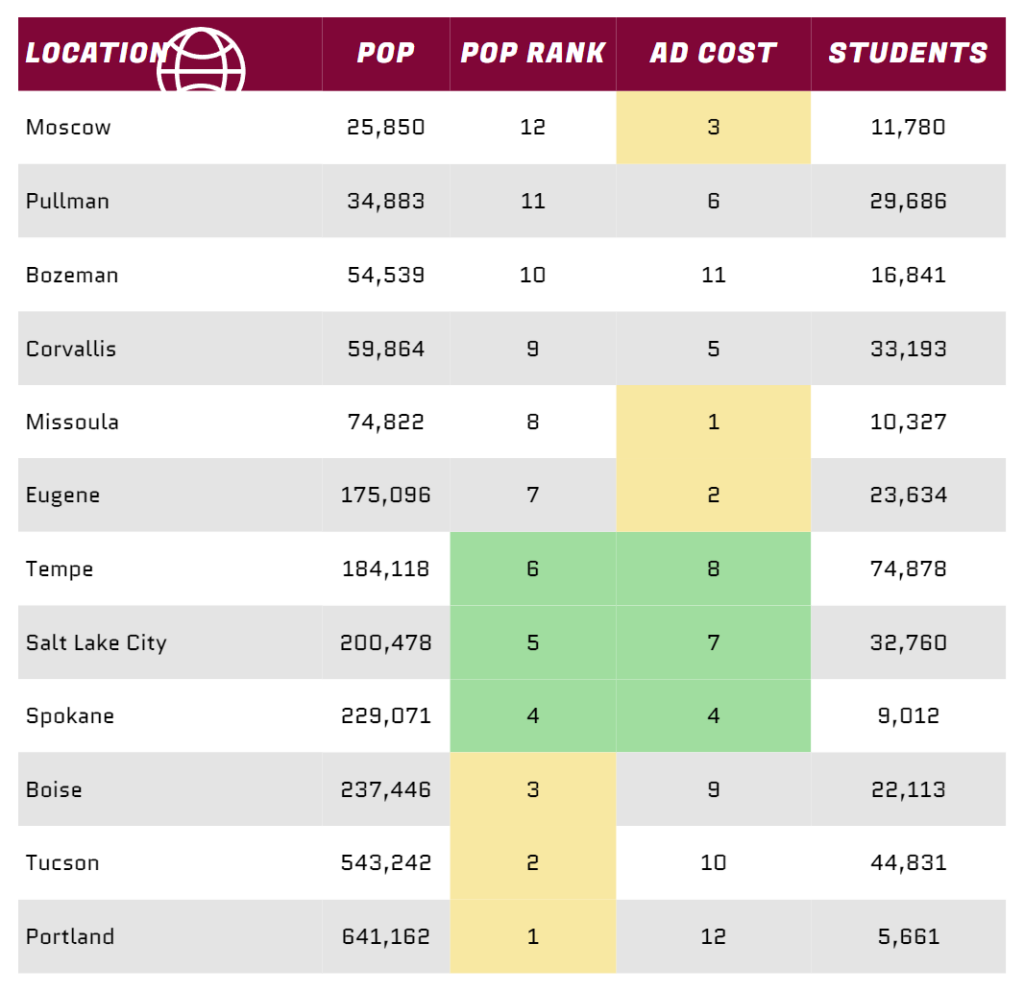
Example chart showing cost of advertising ranked lowest to highest

Continuing with our research for Service Obtainable Market, look at the table to identify the next best market. In doing this research (note: I made up the ranks for ad cost) I ranked the population by highest to lowest, and the ad cost from lowest to highest.  We want a low rank for ad cost and high rank for population. If we can find a 1-2-3 for ad cost and 12-11-10, that would be a good combination. That doesn’t work out. Continuing to seek the best combination, we have Spokane, ranked 4th in population and 4th in ad cost, so we’ll get more bang for our ad buck, reaching a greater number of people than the most populous cities. We should also look at student population. Spokane has Gonzaga University (7256), a WSU campus with 1600 students and UW Medical School with 159. The schools are located close to each other, so this seems like a very good second market. For Salt Lake City, only 16% live on campus, but there are housing neighborhoods very close to campus, so that seems like a very good third market. With the on-campus population and general spread of urban areas taken into account, Tempe may be more desirable if we can find a cooking location that is close to campus or the area where most students live. Some schools have very few on-campus dorms, so there may be more commuters. 22% of University of Arizona students in Tempe live on campus. Tempe may be a good fourth market, but we’ll have to revisit our research by the time we get to focusing on our 4th market.

As you can see, there is a lot of work to do to make a Market Roadmap, and while it will change over time, the research still needs to be done in order to arrive at SOM, your Obtainable Market. It should be done before you create your first investor pitch deck, and I submit once again that it should be done early for your own peace of mind. Is this business I’m starting one that will grow into the SAM and has potential to take a good percentage of the Total Addressable Market, or should I think in terms of dominating a single, first market?

Arriving at SOM – the Serviceable Obtainable Market is difficult, yet rewarding. After doing the research for Total Addressable Market and Service Available Market, the very thoughtful process of getting to SOM is time consuming and entails many small decisions that lead to a plan. Having gone through the basic financial information and then analyzing where and when secondary markets may be established should give a founder a thorough understanding of their industry, expenses and a good idea of a timeline for expansion. SOM – it’s not just for investors!

YouTube video of TAM SAM SOM Overview with good and poor examples.

Getting to SOM – Serviceable Obtainable Market Read More »